
Contributed by Beth Williams, HR Director, Warren Whitney
Poor performance presents an opportunity. Managers should view it as an open door to dialogue with their direct reports. The opportunity is for both the manager and the employee to better understand how best to support each other and succeed in their roles. The manager’s job is not to react first, but to diagnose well.
So, how do we approach poor employee performance? We seek to understand the root cause of the performance issue and address it head-on. As you seek to understand poor performance, ask these five critical questions.
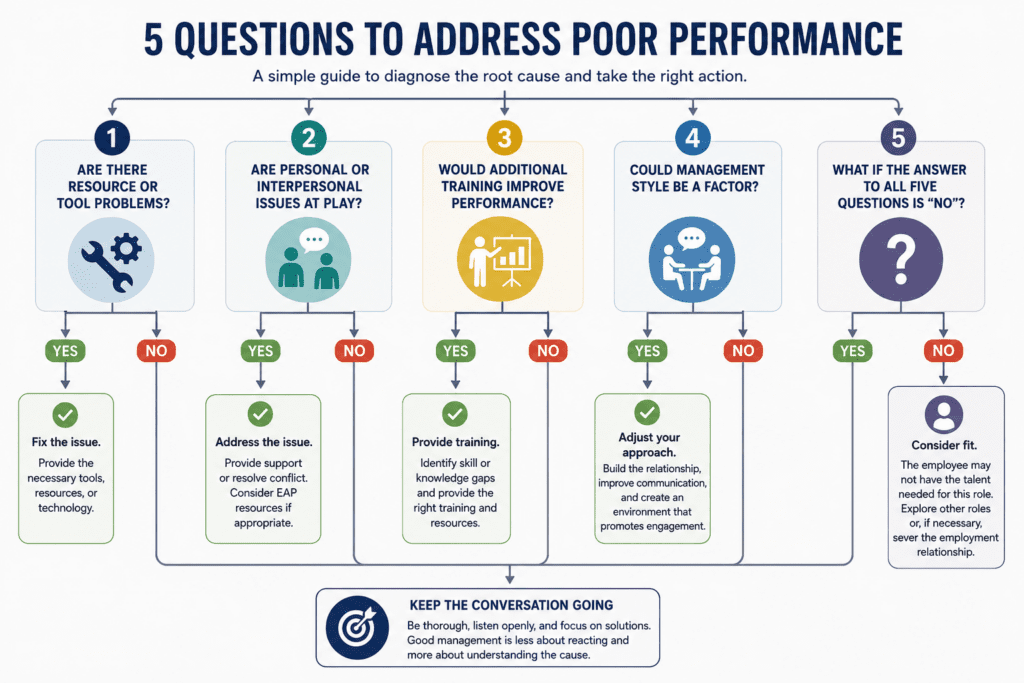
Are There Resource or Tool Problems?
A mechanical issue is a problem the employee does not have control over, such as a tool, piece of equipment, or software that is either faulty or ill-suited for the task. If these issues are discovered, the manager should take responsibility for fixing them so the employee is adequately resourced for success.
Are Personal or Interpersonal Issues at Play?
A personal issue could be any problem related to life outside of the office. It could also be an ongoing issue with another employee, a customer, or a manager. If the problem is outside the office and the employee is open to sharing, the manager could work with the individual to identify what it is and potentially devise a plan to help.
If the problem is coming from within the organization, the manager needs to address the nature of the conflict through the appropriate channels. Acting quickly and deliberately, while listening to all sides of the story, is essential. Using the information collected, determine the underlying issue and work with all parties to find a solution.
An Employee Assistance Program (EAP) can offer confidential help to employees and families and is usually part of an enhanced benefits plan already in place. These resources can provide counseling, financial, legal, and emotional support. Speak with your HR partner to understand if this is an option.
Would Additional Training Improve Performance?
If poor performance is trainable, focus on determining the resources the employee needs to succeed. Ask them what they think they need to improve and listen to why they are frustrated. Verify their feedback with your own investigation to determine what training will help.
Remember, training is helpful only when the issue is a skill or knowledge gap. It is not the answer to every situation.
Could Management Style Be a Factor?
Each employee is an individual and must be managed case by case. If your current approach is not helping this employee perform at their best, focus on getting to know them better. Schedule regular one-on-one time. A coffee conversation, lunch, or a walk outside can all be effective ways to build the relationship.
Understand what motivates them and create an environment that promotes engagement. Asking employees for their ideas on how to improve the work environment, the job, or the overall culture of the organization can instill a sense of ownership that drives better performance.
What if the Answer to all Five Questions is “No?”
If none of the above factors are at play, it is possible the employee does not have the talent needed for success in their current position. It may mean looking within your organization for a better fit. If a better role does not exist, you may need to sever the employment relationship. While this outcome is not ideal, both parties will often be better served in the long run.
The five questions above help outline a clear path when facing performance challenges. When asking them, be thorough and approach the conversation with an open mind. Good management is less about reacting to performance and more about understanding its cause. Poor performance can be an opportunity to reconnect and recalibrate.
Thank you to Beth Williams of Warren Whitney for contributing this article. She is one of the many amazing business leaders who enrich the Virginia CEOs community.
At VACEOs, we believe great leadership never stops growing, and that means creating space for members to learn from the best minds in business. From peer advisory groups to expert-contributed resources like this one, everything we do is designed to help Virginia’s top CEOs lead with more clarity, confidence, and connection. Thank you, Beth, for sharing your expertise with our community.
To learn more about Warren Whitney, reach out to Kyle Ficker at kficker@warrenwhitney.com, Stephanie Ford at sford@warrenwhitney.com, or call 804.282.9566.